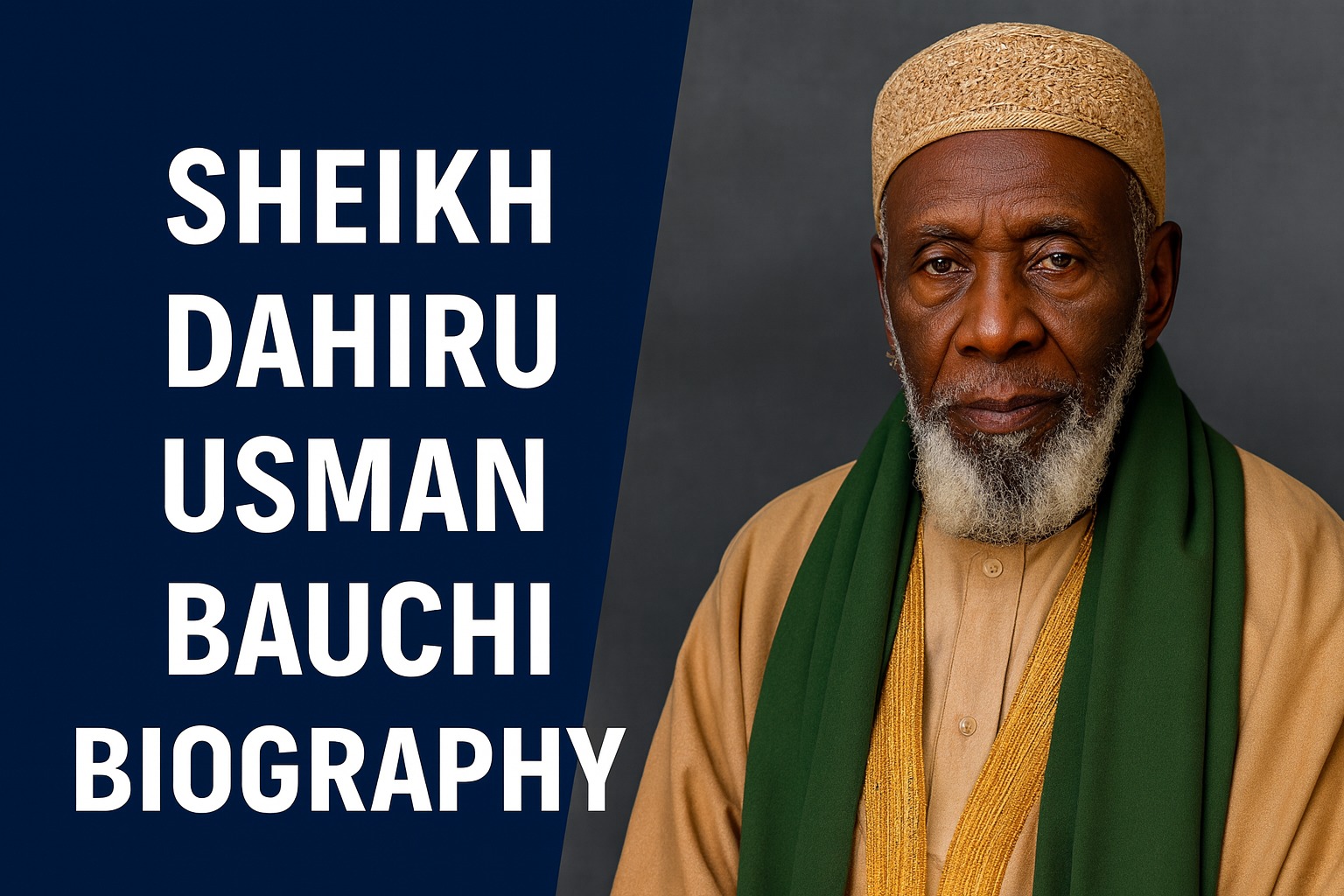
Sheikh Dahiru Usman Bauchi was one of the most revered Islamic scholars in Nigeria and West Africa. Known for his deep knowledge of the Qur’an, his leadership in the Tijaniyya Sufi order, and his lifelong commitment to Islamic education, Sheikh Dahiru’s legacy spans nearly a century. Born in 1927 and passing away in 2025, he lived a life of devotion, scholarship, and service to humanity. His biography is not just a story of personal achievement it is a chronicle of Islamic revivalism, spiritual leadership, and cultural impact.
Early Life and Family Background
Sheikh Dahiru Usman Bauchi was born on June 29, 1927, in Nafada, a town that was then part of Bauchi Province before the creation of Gombe State. His birth name was Dahiru Usman, and he hailed from a devout Muslim family deeply rooted in Islamic tradition. His father, Usman, was a respected Islamic teacher, and his mother was known for her piety and wisdom.
Growing up in a region rich in Islamic scholarship, Dahiru was immersed in religious teachings from an early age. His family emphasized Qur’anic memorization, moral discipline, and spiritual awareness. These early influences shaped his lifelong commitment to Islam and laid the foundation for his future as a scholar and leader.
Education
Sheikh Dahiru’s formal Islamic education began in his hometown, where he studied under local scholars. He quickly distinguished himself as a gifted student, memorizing the Qur’an at a young age and mastering classical Arabic. His thirst for knowledge led him to travel across Northern Nigeria and beyond, seeking advanced instruction in Tafsir (Qur’anic exegesis), Hadith, Fiqh (Islamic jurisprudence), and Sufism.
He studied under more than 15,000 teachers throughout his life, a testament to his dedication to learning. His education was rooted in the Maliki school of jurisprudence, and he became a prominent figure in the Tijaniyya Sufi order, which emphasizes spiritual purification, remembrance of God (dhikr), and communal harmony.
Career
Sheikh Dahiru’s career as an Islamic scholar and preacher began in the 1950s. He gained recognition for his eloquent Tafsir sessions, which attracted thousands of listeners during Ramadan and other religious occasions. His ability to explain complex religious concepts in Hausa and Arabic made him accessible to a wide audience.
He established numerous Qur’anic schools across Nigeria, training generations of scholars and students. His teachings emphasized the importance of peace, tolerance, and unity among Muslims. As his influence grew, he became the Grand Leader of the Tijaniyya Movement in Nigeria, a position that placed him at the forefront of Islamic spiritual leadership in West Africa.
Achievements
- Supreme Leader of Tijaniyya in Nigeria: His leadership unified millions of followers under a peaceful and spiritually rich interpretation of Islam.
- Tafsir al-Qur’an: His commentaries on the Qur’an are widely respected and used in Islamic institutions.
- Educational Outreach: He trained over 10 million students, directly and indirectly.
- Advocacy for Peace: He was a vocal advocate for religious tolerance and interfaith dialogue.
- National Recognition: He was awarded the Order of the Federal Republic (OFR) for his contributions to national development and religious harmony.
Marriage and Personal Life
Sheikh Dahiru Usman Bauchi was married and had a large family. He is estimated to have had 61 children, including notable figures like Ibrahim Dahiru Bauchi, Tijani Dahiru Bauchi, and Bashir Dahiru Bauchi. His family continues to uphold his teachings and legacy.
Despite his fame, Sheikh Dahiru lived a modest life. He was known for his humility, generosity, and deep spirituality. He often traveled to remote areas to teach and preach, never turning away those who sought his guidance.
Net Worth
While Sheikh Dahiru was not known for material wealth, his influence and reach were vast. His net worth is not publicly documented, but his legacy includes:
- Thousands of Qur’anic schools
- Millions of followers
- A vast library of religious texts and commentaries
- Influence in religious and political circles
His true wealth lay in his knowledge, his students, and the spiritual impact he left on the Muslim world.
Awards and Honors
- Order of the Federal Republic (OFR): One of Nigeria’s highest honors
- Honorary titles from Islamic organizations across Africa
- Recognition from international Islamic scholars and institutions
- Tributes from Nigerian presidents, governors, and traditional rulers
These awards reflect his role as a bridge between tradition and modernity, scholarship and spirituality.
Cause of Death
Sheikh Dahiru Usman Bauchi passed away on November 26, 2025, at the age of 98. His death marked the end of an era in Nigerian Islamic scholarship. He was buried in Bauchi on November 28, 2025, with thousands of mourners attending his funeral.
His passing was mourned across Nigeria and the Muslim world, with tributes pouring in from religious leaders, politicians, and ordinary citizens.
Conclusion
Sheikh Dahiru Usman Bauchi’s life was a beacon of faith, scholarship, and service. From humble beginnings in Nafada to becoming the supreme leader of the Tijaniyya movement, his journey is a testament to the power of knowledge and devotion. His teachings continue to inspire millions, and his legacy lives on through his students, writings, and institutions.
He was more than a scholar he was a spiritual guide, a teacher, and a symbol of unity in a diverse religious landscape.
FAQs
What was Sheikh Dahiru Usman Bauchi known for?
He was known for his Qur’anic exegesis, leadership in the Tijaniyya Sufi order, and Islamic education.
How many children did he have?
He had an estimated 61 children, including prominent Islamic scholars.
What was his main religious affiliation?
He was a follower and leader of the Tijaniyya Sufi order and adhered to the Maliki school of jurisprudence.
When did he die?
He died on November 26, 2025, at the age of 98.
What is his legacy?
His legacy includes millions of students, Qur’anic schools, religious commentaries, and a reputation for peace and unity.